 Skip to content

Brute Force Attacks in 2025: How They Work, What’s Changed and How to Stop Them
Brute force attacks might sound like a relic from cybersecurity’s past – a blunt, unsophisticated method of guessing passwords until one works. But in 2025, these types of cybercrime are still relevant – and in fact, can be more dangerous than ever.
New technology such as automation and artificial intelligence, along with vast databases of stolen credentials, mean modern threat actors are able to exploit weak authentication systems across a variety of platforms. These attacks are often the first step in larger breaches, enabling ransomware deployment or data exfiltration.
Brute Force in 2025: Smarter, Stealthier and More Dangerous
Brute force attacks have come a long way from the days of overwhelming login forms with password guesses. Over the past few years, attackers have transformed this once-crude attack vector into a sophisticated, AI-powered process. This dramatically reduces the number of attempts needed to crack an account and increases the odds of a successful breach.
At the same time, businesses are facing a dramatic expansion of their attack surface. Remote work, cloud services, IoT devices and third-party integrations have introduced countless new endpoints to networks, many of which lack the hardened authentication protocols required to defend against brute force attacks.
Many of these may be compromised by weak, reused or easily guessed passwords. With cybercriminals constantly scanning the internet for soft targets, it only takes one entry point to open the door to threats like ransomware or data theft.
Real-World Brute Force Attacks in 2025
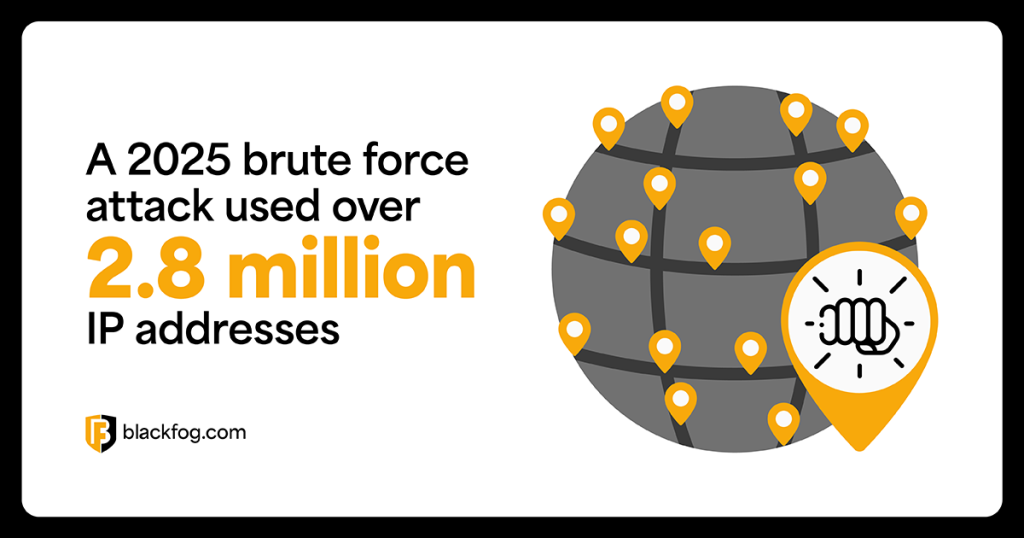
Several warnings have been issued recently about the threats posed by brute force attacks. In early 2025, a massive brute force campaign leveraged over 2.8 million IP addresses to target VPNs, firewalls and edge devices from vendors like Palo Alto Networks, Ivanti, and SonicWall. This aimed to infiltrate edge security appliances, highlighting the scale and sophistication of modern brute force operations.
Modern brute force attacks have also evolved beyond simple password guessing. Variations include:
- Credential stuffing: This uses leaked credentials from previous breaches to gain unauthorized access.
- Password spraying: This involves using commonly used passwords across many accounts to avoid detection.
- Reverse brute force: This technique begins with a known password, then looks for matching usernames.
Meanwhile, machine learning models trained on leaked password dumps can now generate highly targeted guesses based on user behavior, language patterns, job roles, or even regional naming conventions.
The combination of these advanced tools and techniques has therefore turned brute force attacks from a nuisance to a persistent and evolving threat that must be taken seriously in today’s cybersecurity landscape.
Stopping Brute Force in 2025: Detection and Defense that Actually Works
In 2025, brute force attacks are often subtle and designed to evade legacy defenses. This means that traditional detection methods against these attacks, such as counting failed logins, are unable to detect the latest generation of attacks in time.
Instead, firms need to adopt real-time behavioral analysis tools that can be deployed across all endpoints. This is where tools such as user and entity behavior analytics (UEBA) come in.
By learning what normal behavior looks like across your environment, these tools can flag unusual access patterns and login attempts from new locations. If a brute force attempt does succeed, firms can also spot telltale next steps, such as privilege escalation, and block any suspicious activities.
Another powerful detection strategy is the use of honeypots and decoy accounts. These can provide an early warning system that flags attackers as they probe for weak spots or distract hackers from genuinely valuable targets.
A Layered Approach to Defending Against Cyberattacks
Detection alone isn’t enough. Businesses also need modern, layered mitigation strategies to stop brute force attacks in their tracks, as well as take steps to mitigate any damage should attacks successfully breach systems.
Among the technologies and tools that are necessary for this are:
- Multifactor authentication: Having this across the network is a must, but they must be hardened against fatigue attacks and bypass tools that aim to take advantage of the human element.
- Zero Trust architecture: This ensures that no user or device is trusted by default, making it harder for hackers to move laterally within a network after an initial breach.
- Passwordless authentication: Alternative methods such as biometrics or physical tokens can eliminate one of brute force’s biggest targets.
- Effective employee training: Reiterating the importance of good password practices – not just hard-to-guess passwords, but unique details that are hard for brute force attacks to crack – should be a key part of security training.
- Behavior-based endpoint protection: Solutions such as anti data exfiltration can respond to anomalies in real-time and block unauthorized attempts to remove data from the network, even if a user’s credentials seem valid.
Together, these solutions provide a blueprint for stopping brute force attacks before they become full-blown breaches and ensure that sensitive data is protected from threats like ransomware.
Share This Story, Choose Your Platform!
Related Posts

From Zoom Calls to Desert Adventures: Our First Ever BlackFog Kick Off
BlackFog’s first global Kick Off brought the team together in Arizona for strategy, connection, and unforgettable desert adventures.

DaVita Ransomware Attack: 2.7M Affected in Major Data Breach
The DaVita ransomware attack exposed 2.7 million patient records. Learn what happened, what data was stolen, and how the Interlock gang pulled it off.

Confronting INC Ransom: BlackFog’s Prevention-First Strategy for Affiliate-Driven Ransomware
Confronting INC Ransom, BlackFog’s Prevention-First Strategy for Affiliate-Driven Ransomware.

CamoLeak: How GitHub Copilot Became An Exfiltration Channel
CamoLeak (CVE-2025-59145) turned GitHub Copilot into a silent data exfiltration channel via prompt injection and GitHub's own image proxy. CVSS 9.6.
The State of Ransomware: March 2026
BlackFog's state of ransomware March 2026 measures publicly disclosed and non-disclosed attacks globally.

Venom Stealer Turns ClickFix Into a Full Exfiltration Pipeline
BlackFog analyzes Venom Stealer, a new MaaS infostealer that uses ClickFix delivery to launch an automated exfiltration pipeline covering credential theft, wallet cracking, and fund sweeping.